


The Complete Guide to Web3 PR: Building Trust, Earning Media Coverage, and Growing Your Brand
Web3 PR is the process of building trust, credibility, visibility, and authority for blockchain projects, crypto startups, DeFi protocols, NFT platforms, GameFi ecosystems, and other Web3 businesses. While many people associate public relations with press releases and media coverage, modern Web3 PR is much broader. It involves strategic storytelling, founder branding, media outreach, thought leadership, reputation management, and community communication.
In an industry where competition is growing rapidly and trust remains one of the biggest challenges, having a great product is rarely enough. Users want transparency. Investors want confidence. Journalists want meaningful stories. Partners want proof that a project is credible and positioned for long-term growth. This is why public relations has become an essential component of Web3 marketing rather than an optional activity.
Whether you're launching a token, scaling a DeFi platform, building an RWA project, or growing a blockchain startup, understanding Web3 PR can significantly influence your ability to attract attention, earn trust, and establish a strong market presence. This guide explains how Web3 PR works, why it matters, and how projects can use it to create sustainable growth.
What Is Web3 PR?
Web3 PR, also known as crypto PR or blockchain PR, is the strategic practice of managing a project's reputation and visibility through media relations, thought leadership, community engagement, founder branding, and strategic communication.
The primary objective of Web3 PR is not simply to gain attention. It is to build trust.
Unlike advertising, where brands pay for visibility, public relations focuses on earning credibility through third-party recognition and meaningful communication.
When someone discovers a new blockchain project, they often evaluate several trust signals before engaging with it. They look at the founding team, media coverage, community activity, transparency, and industry reputation. Effective Web3 PR helps strengthen these trust signals and improve public perception.
Why Public Relations Matters in Web3

The blockchain industry operates differently from many traditional industries.
Innovation moves quickly. Competition is intense. New projects launch every day. At the same time, users and investors are often cautious because of past experiences involving scams, rug pulls, failed projects, and unrealistic promises.
This creates a unique challenge.
Projects need visibility, but visibility alone is not enough.
People must also believe that the project is legitimate, trustworthy, and capable of delivering long-term value.
This is where public relations becomes important.
A strong PR strategy helps bridge the gap between what a project does and how the market perceives it.
It allows projects to communicate their vision clearly, demonstrate expertise, and earn recognition from trusted industry sources.
The Main Goals of Web3 PR
Although every project has different objectives, most Web3 PR campaigns focus on several common goals.
Building Credibility
Trust remains one of the most valuable assets in Web3.
Public relations helps projects establish credibility through:
Media coverage
Founder visibility
Educational content
Industry participation
Consistent communication
Increasing Visibility
Many projects struggle because they lack awareness rather than innovation.
PR helps increase exposure among:
Potential users
Investors
Developers
Industry leaders
Strategic partners
Strengthening Brand Authority
Projects that consistently share valuable insights often become recognized as authorities within their niche.
Authority creates opportunities for growth, partnerships, and media attention.
Supporting Long-Term Growth
Unlike many short-term promotional tactics, PR contributes to long-term brand development.
A strong reputation can continue generating value long after individual campaigns end.
Web3 PR vs Traditional PR
Although both forms of public relations share similar principles, they operate in different environments.
Factor | Traditional PR | Web3 PR |
Primary Goal | Brand Awareness | Trust & Authority |
Main Audience | Consumers | Users, Investors, Developers |
Community Importance | Moderate | Very High |
Technical Education | Limited | Essential |
Founder Visibility | Important | Critical |
Trust Challenges | Moderate | High |
Web3 projects often need to educate audiences while simultaneously building credibility. This makes strategic communication even more important.
Why Web3 Projects Need PR
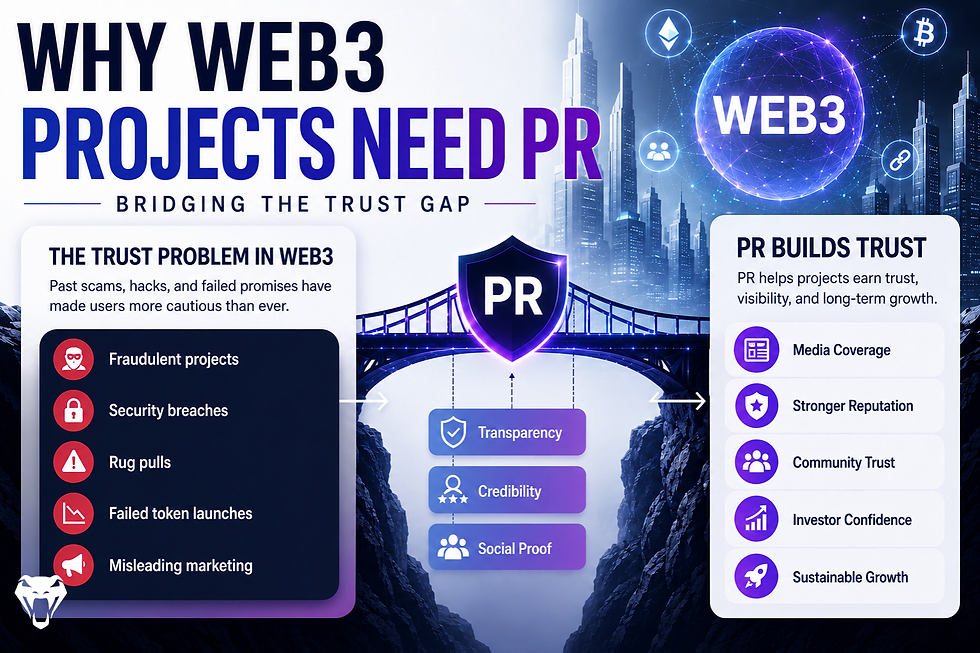
Trust is one of the biggest challenges facing blockchain projects today.
The industry has produced remarkable innovations, but it has also experienced numerous controversies.
Over the years, users have witnessed:
Fraudulent projects
Security breaches
Rug pulls
Failed token launches
Misleading marketing campaigns
As a result, people have become more cautious.
When users discover a new project, they rarely ask, "How does the technology work?" as their first question.
Instead, they ask:
Can I trust this project?
Who is behind it?
Is the team experienced?
Has the project been covered by reputable media outlets?
What makes it different from competitors?
These questions reflect a trust gap.
Public relations helps close that gap by providing transparency, credibility, and social proof.
Why Great Projects Often Remain Invisible
Many founders assume that exceptional technology automatically attracts attention, but in reality, that rarely happens. Every year, countless blockchain startups launch innovative products with experienced teams and strong technical foundations, yet many struggle to gain traction. The reason is simple: people cannot engage with a project they have never heard about. Visibility plays a crucial role in growth, and without effective communication, even the most innovative solutions can remain unnoticed.
This is where Web3 PR becomes valuable, helping projects ensure that important milestones, achievements, and innovations reach the right audience through the right channels at the right time.
How PR Influences User Adoption
Trust influences behavior.
Users are more likely to engage with platforms that appear transparent, credible, and professionally managed.
Media coverage, founder visibility, educational content, and community engagement all contribute to stronger trust signals.
Imagine two similar projects entering the market.
One project communicates regularly, participates in industry conversations, secures media coverage, and maintains transparency.
The other project remains largely silent.
Most users will naturally feel more comfortable engaging with the first project.
This demonstrates the influence of public perception on adoption.
How PR Influences Investors
Investors evaluate more than technology.
They also consider:
Team credibility
Market positioning
Industry reputation
Brand recognition
Community sentiment
Strong PR can improve investor confidence by demonstrating that a project is gaining recognition and building momentum.
While media coverage alone does not secure investment, it can support a broader narrative of growth and credibility.
How PR Influences Strategic Partnerships
Partnerships often depend on trust.
Organizations are more likely to collaborate with projects that demonstrate professionalism and credibility.
A strong public reputation can make partnership discussions easier and create opportunities that might not otherwise exist.
For Web3 startups seeking exchange listings, ecosystem partnerships, or institutional relationships, reputation can become a competitive advantage.
How Web3 PR Works
Successful Web3 PR is not a single activity.
It is a structured process involving positioning, communication, storytelling, media outreach, and reputation management.
Step 1: Positioning
Positioning determines how a project is perceived within the market.
Without positioning, communication becomes inconsistent and confusing.
A strong positioning strategy answers questions such as:
What problem does the project solve?
Why is that problem important?
Who benefits from the solution?
How is the project different from alternatives?
For example:
Weak positioning:
"We are a blockchain infrastructure company."
Strong positioning:
"We help institutions bring real-world assets on-chain through secure and compliant infrastructure."
The second statement is more specific and easier to understand.
Effective positioning creates clarity.
Clarity improves understanding.
Understanding supports trust.
Step 2: Messaging
Once positioning is established, projects need clear messaging.
Messaging ensures consistency across:
Website content
Press releases
Interviews
Social media
Community updates
Consistent messaging strengthens recognition and improves credibility.
Projects that frequently change their narrative often create confusion among users and investors.
Step 3: Story Development
Journalists rarely cover projects simply because they exist.
They cover stories.
A strong story often connects project developments with larger industry trends.
Examples include:
Product launches
Research findings
Funding announcements
Strategic partnerships
User growth milestones
Industry insights
The stronger the story, the greater the opportunity for meaningful media coverage.
Step 4: Media Outreach
Media outreach involves building relationships with journalists, editors, analysts, and content creators.
Successful outreach focuses on relevance.
Instead of sending generic pitches to hundreds of contacts, effective PR teams prioritize quality and personalization.
Best practices include:
Understanding the journalist's audience
Providing relevant information
Offering expert insights
Sharing unique stories
Following up professionally
Quality outreach consistently outperforms mass outreach.
Step 5: Thought Leadership
Thought leadership positions founders and executives as trusted industry voices.
People trust expertise.
Founders who consistently share valuable perspectives often attract more media attention and community engagement.
Thought leadership activities may include:
Guest articles
Podcasts
Conference speaking
Industry commentary
Research reports
Over time, these activities contribute to stronger authority and credibility.
Step 6: Community Amplification
Communities play a central role in Web3 growth.
Strong communities amplify messages, increase visibility, and reinforce trust.
Community amplification may involve:
Educational content
AMA sessions
Ecosystem updates
Transparent discussions
Social media engagement
When communities become advocates, growth often accelerates naturally.
Step 7: Reputation Management
Every project eventually faces challenges.
These may include:
Market volatility
Product issues
Security incidents
Negative publicity
How a project responds to these situations often influences trust more than the situation itself.
Transparent communication, accountability, and proactive engagement are critical components of effective reputation management.
Projects that handle challenges professionally often emerge stronger and more trusted than before.
What Can Web3 PR Actually Help You Achieve?

One of the most common questions founders ask is whether public relations is worth the investment.
The answer depends on expectations.
PR is not a shortcut to overnight growth.
However, it can contribute significantly to long-term success.
A strong Web3 PR strategy can help projects:
Increase Brand Visibility
Media coverage and industry recognition expose projects to new audiences and opportunities.
Build Credibility
Trust remains a critical factor in user adoption and investor confidence.
Strengthen Investor Confidence
Recognition from respected industry sources can reinforce positive perceptions.
Improve User Acquisition
Projects with stronger trust signals often convert interest into adoption more effectively.
Create Partnership Opportunities
A positive reputation can attract strategic relationships.
Establish Long-Term Authority
Consistent communication and thought leadership contribute to lasting brand equity.
The most successful Web3 brands rarely focus solely on promotion.
They focus on building trust, authority, and meaningful relationships over time.
Types of Web3 PR Campaigns
Not every Web3 project requires the same public relations strategy. A newly launched startup has different communication goals than an established protocol, while a token launch requires a different approach than an exchange listing announcement.
Understanding the different types of Web3 PR campaigns helps founders choose the right strategy for their stage of growth.
Startup Launch PR
Startup launch PR focuses on introducing a project to the market.
The goal is not simply to announce that a company exists. The objective is to communicate why the project matters, what problem it solves, and why people should pay attention.
A startup launch campaign often includes:
Founder interviews
Industry thought leadership
Media outreach
Brand storytelling
Educational content
Community-building initiatives
The strongest startup launches focus on building credibility rather than generating hype.
Token Launch PR
Token launches often attract significant attention, making communication especially important.
A successful token launch campaign focuses on:
Transparency
Education
Community engagement
Media communication
Risk awareness
Projects that prioritize clear communication often build stronger trust during launch periods.
DeFi PR
Decentralized Finance projects often face challenges related to complexity and trust.
Many users struggle to understand technical concepts such as:
Liquidity pools
Yield farming
Staking
Lending protocols
Cross-chain infrastructure
DeFi PR helps simplify these concepts while demonstrating security, transparency, and utility.
NFT PR
NFT projects often rely heavily on storytelling and community engagement.
Successful NFT public relations campaigns typically focus on:
Creator stories
Community culture
Utility
Partnerships
Long-term vision
Projects that focus only on hype often struggle to maintain attention after launch.
GameFi PR
Gaming communities evaluate projects differently from traditional crypto audiences.
GameFi PR often focuses on:
Gameplay experience
User engagement
Community building
Development updates
Strategic partnerships
Players care about entertainment and sustainability as much as tokenomics.
RWA PR
Real World Asset projects require a strong emphasis on trust and compliance.
Because these projects often connect traditional finance with blockchain infrastructure, communication must address:
Transparency
Regulation
Security
Asset backing
Institutional credibility
RWA marketing and Web3 PR often overlap because education plays such an important role.
Founder Branding Campaigns
Many successful Web3 companies invest heavily in founder branding.
People trust people more than logos.
When founders consistently share insights, participate in discussions, and contribute valuable perspectives, they strengthen the credibility of their projects.
Founder branding can include:
Podcast appearances
Guest articles
Conference speaking
Social media thought leadership
Industry commentary
Over time, founder authority becomes a powerful trust signal.
How to Get Media Coverage for a Web3 Project
One of the most common questions founders ask is:
"How do we get featured in crypto media?"
The answer is not as simple as sending a press release.
Media coverage is earned through relevance, credibility, and newsworthiness.
What Journalists Actually Look For
Journalists receive countless pitches every week.
Most are ignored.
The reason is simple.
Many projects focus on what they want to announce rather than why readers should care.
Journalists typically evaluate stories based on:
Relevance
Originality
Timeliness
Industry impact
Audience interest
A product update that changes nothing for users may not be newsworthy.
A partnership that solves a significant industry challenge may attract attention.
What Makes a Story Newsworthy?
Not every announcement deserves media coverage.
The strongest stories often involve:
Major partnerships
Funding rounds
Significant adoption milestones
Product innovations
Industry research
Market insights
Founders should ask:
"Why would someone outside our company care about this?"
If the answer is unclear, the story likely needs refinement.
How to Pitch Crypto Journalists
Successful media outreach is built on relationships and relevance.
Best practices include:
Research Before Reaching Out
Understand:
What topics the journalist covers
Who their audience is
What type of stories they publish
Personalize Communication
Generic outreach rarely works.
Personalized pitches demonstrate professionalism and increase response rates.
Focus on Value
Instead of explaining why your project is amazing, explain why the story matters to the journalist's audience.
Keep It Concise
Journalists are busy.
Clear communication improves engagement.
Press Releases in Web3: Do They Still Work?
Press releases remain an important part of Web3 PR, but their role has evolved significantly. They are no longer effective simply because they are published. Instead, their success depends on the value of the announcement and how well it supports a broader communication strategy. A well-crafted press release can help blockchain projects communicate major developments, provide accurate information to journalists, and strengthen brand visibility.
However, not every update deserves a press release. Understanding what a crypto press release is, when it should be used, and how to maximize its impact is essential for generating meaningful results from public relations efforts.
What Is a Crypto Press Release?
A crypto press release is an official announcement distributed to media outlets and industry publications.
Common topics include:
Funding rounds
Partnerships
Product launches
Exchange listings
Major milestones
The purpose is to provide journalists with accurate information and create awareness around significant developments.
When Should You Publish a Press Release?
Press releases work best when there is genuine news.
Examples include:
Raising capital
Launching a major product
Entering a strategic partnership
Reaching a significant milestone
If there is no meaningful announcement, a press release is unlikely to generate results.
When Press Releases Don't Work
Many projects distribute announcements that offer little value.
Examples include:
Minor updates
Generic feature releases
Self-promotional statements
Recycled information
These announcements rarely attract meaningful attention.
Press Release Best Practices
Effective press releases should:
Lead with the news
Provide context
Include quotes
Explain significance
Maintain clarity
The goal is not simply to publish content.
The goal is to communicate something meaningful.
Web3 PR vs SEO vs Content Marketing vs KOL Marketing
Many founders view these channels as competing strategies.
In reality, they work best together.
Factor | Web3 PR | SEO | Content Marketing | KOL Marketing |
Main Goal | Trust & Authority | Search Visibility | Education | Awareness |
Long-Term Value | High | High | High | Medium |
Brand Credibility | Very High | Medium | High | Medium |
GEO Impact | High | High | High | Medium |
AEO Potential | High | High | High | Low |
Traffic Generation | Moderate | High | High | Moderate |
Community Influence | High | Medium | Medium | High |
Which Strategy Should Projects Prioritize?
There is no universal answer.
The best approach depends on goals.
If the objective is search visibility, SEO becomes critical.
If the objective is authority and trust, Web3 PR plays a larger role.
If the objective is education, content marketing becomes important.
If the objective is rapid exposure, KOL marketing may help.
The strongest growth strategies combine all four.
Why These Channels Work Better Together
Consider the relationship between PR and SEO.
PR generates:
Brand mentions
Media coverage
Authority signals
SEO benefits from:
Brand recognition
High-quality mentions
Increased trust
Similarly, content marketing supports both PR and SEO by creating educational resources that audiences can discover and share.
Common Web3 PR Mistakes
Even strong projects can undermine their credibility through poor communication.
Buying Low-Quality Placements
Many projects focus on quantity rather than quality.
A handful of meaningful placements often provides more value than dozens of low-quality mentions.
Chasing Vanity Metrics
Media mentions alone do not guarantee success.
Founders should focus on meaningful outcomes rather than superficial numbers.
Ignoring Founder Branding
Founders are often among the strongest trust signals available.
Projects that neglect founder visibility miss valuable opportunities.
Sending Generic Press Releases
Generic announcements rarely attract attention.
Projects should focus on meaningful stories rather than routine updates.
Inconsistent Communication
Trust requires consistency.
Long periods of silence can create uncertainty.
Treating PR as a One-Time Activity
Public relations is not a one-time campaign.
It is an ongoing process of building relationships and credibility.
How to Measure Web3 PR Success

One of the biggest misconceptions about public relations is that success is measured solely by media coverage.
In reality, effective measurement requires a broader perspective.
Media Mentions
Media coverage remains an important indicator of visibility.
However, quality matters more than quantity.
Brand Mentions
Brand mentions across publications, social platforms, podcasts, and industry discussions can indicate growing recognition.
Share of Voice
Share of voice measures how often a project is discussed compared to competitors.
This can provide valuable insights into market visibility.
Referral Traffic
Media placements can drive visitors directly to a project's website.
Tracking referral traffic helps evaluate impact.
Organic Search Growth
Strong PR often supports SEO by increasing brand awareness and authority.
Over time, projects may experience growth in branded search volume and organic visibility.
Community Growth
Increased community participation can indicate stronger brand awareness.
Metrics may include:
Discord growth
Telegram activity
Social engagement
Newsletter subscriptions
Investor Interest
More inbound inquiries, partnership discussions, and investor conversations can signal positive PR outcomes.
The Future of Web3 PR
The future of Web3 PR will be shaped by trust, authority, and AI-driven discovery.
AI Search and GEO
Generative Engine Optimization (GEO) is becoming increasingly important.
AI systems rely on trusted sources and recognizable entities when generating responses.
Projects with stronger digital authority are more likely to be referenced.
AEO and Answer Engines
Answer Engine Optimization focuses on creating content that directly answers user questions.
This aligns closely with effective public relations because both prioritize clarity and trust.
Entity-Based Search
Search engines increasingly evaluate entities rather than isolated keywords.
Strong brands benefit from recognition across multiple trusted sources.
E-E-A-T Signals
Experience, Expertise, Authoritativeness, and Trustworthiness remain critical.
Projects that demonstrate genuine expertise and transparent communication are more likely to earn long-term visibility.
Brand Authority Will Matter More
As AI-generated content becomes more common, brand authority will become an even stronger differentiator.
Projects that invest in credibility today may gain significant advantages in the future.
Conclusion
Web3 PR is not simply about getting mentioned in media outlets or distributing press releases. It is a strategic discipline focused on building trust, credibility, authority, and long-term brand value.
In an industry where users, investors, and partners are constantly evaluating risk, trust often becomes the deciding factor between growth and obscurity.
Projects that communicate clearly, educate consistently, engage transparently, and contribute meaningful insights are more likely to earn attention and recognition over time.
While technology remains important, successful Web3 brands understand that adoption depends on more than innovation alone. It depends on how effectively they communicate their value, establish credibility, and build lasting relationships with the people they serve.
Ultimately, the strongest Web3 projects are not always the loudest. They are often the most trusted.
Frequently Asked Questions:
What is Web3 PR?
Web3 PR is the practice of building trust, credibility, authority, and visibility for blockchain projects through strategic communication, media relations, thought leadership, and community engagement.
How much does Web3 PR cost?
Costs vary significantly depending on scope, goals, geography, and agency experience. Some projects manage PR internally, while others work with specialized Web3 PR agencies.
Is Web3 PR worth it?
For many projects, yes. Public relations can strengthen trust, improve visibility, support fundraising efforts, and contribute to long-term brand growth.
How long does PR take to show results?
PR is generally a long-term investment. While some campaigns generate immediate visibility, meaningful reputation building often takes months rather than weeks.
Can PR help fundraising?
PR can improve visibility and credibility, which may create more favorable conditions for fundraising discussions.
What is the difference between PR and marketing?
Marketing focuses on promoting products and generating growth. PR focuses on building trust, credibility, and reputation.
Are press releases still effective?
Yes, when they communicate meaningful news and are supported by a broader communication strategy.
How do Web3 startups get media coverage?
Successful projects earn coverage by sharing relevant stories, building relationships with journalists, demonstrating expertise, and creating newsworthy announcements.


